
Interior Design Styles in Singapore: 10 Types for HDB & Condo (2026)
A style-by-style showcase, each one paired with a real Swiss Interior project, and how the look actually plays out in HDB flats and condos here.
Before you pick a single tile or sofa, there's a bigger decision sitting underneath all of it: what style is this home going to be? Get that right and everything afterwards gets easier, because every choice has something to answer to. Get it vague, and you end up with a home that looks like a showroom floor, nice pieces that don't quite talk to each other.
So this is an overview of different interior design styles actually shaping Singapore homes in 2026, each one paired with a project from our own portfolio. You'll notice a thread running through most of them, warmth, natural materials, a bit of restraint, because that's where local taste has landed. But each style gets there its own way, and the differences are where the fun is.
1. Warm Minimalism

Warm minimalism is the natural starting point for a new BTO like our Blk 460 Bukit Batok West, where there's no existing baggage to design around, and the goal is a calm, liveable home from day one. The style keeps the clean, uncluttered bones of classic minimalism but warms up the cold white box nobody actually wanted to live in. Think creamy off-white walls, pale oak across the flooring and a low TV console, a soft-textured sofa, and very little left on display. Texture does the work that colour would in a busier home: the grain of the wood, the weave of the linen, a hint of plaster on a feature wall. In a five-room flat, it reads as spacious and serene rather than empty.
Minimalist interior design the single most-requested direction in Singapore right now. In our experience, roughly four in five enquiries ask for some form of minimalism, and a home like this shows why.
2. Japandi

Japandi takes that same calm base and gives it more soul, which makes it a lovely fit for a family BTO like our Bidadari 4-room. It blends Japanese wabi-sabi with Scandinavian hygge: a muted, earthy palette of soft beiges and warm greys, grounded by a few darker accents you won't find in pure Scandinavian, a charcoal timber, a near-black frame. Furniture sits low, lines stay simple, and natural materials carry the mood: oak, linen, ceramic, and a rattan pendant.
What separates Japandi style from plain minimalism is intention: fewer pieces, but each one chosen to be looked at. It's become hugely popular with Singapore homeowners because it reads as clean and cosy at the same time, a hard balance to strike in a compact flat. If you're weighing it against the stricter Muji look, the two are worth comparing side by side.
3. Muji

Muji style borrows its name and its whole philosophy from the Japanese brand: simple, functional, quietly made, no logos shouting at you. It suits a compact BTO like our 315A Punggol Way 4-room, where storage and clarity matter far more than statement pieces. Next to Japandi, it's a touch more austere and a lot more practical, cooler neutrals warmed up with light wood, and the real hero is concealed storage that keeps every surface clear.
That clarity is the entire point of Muji: a home that feels orderly and unfussy, where everything has a place, and nothing competes for attention. It makes a tight flat feel restful rather than cramped, which is exactly what you want in a four-room flat. If this is your direction, our full Muji interior design guide goes deeper on getting the look room by room.
4. Scandinavian
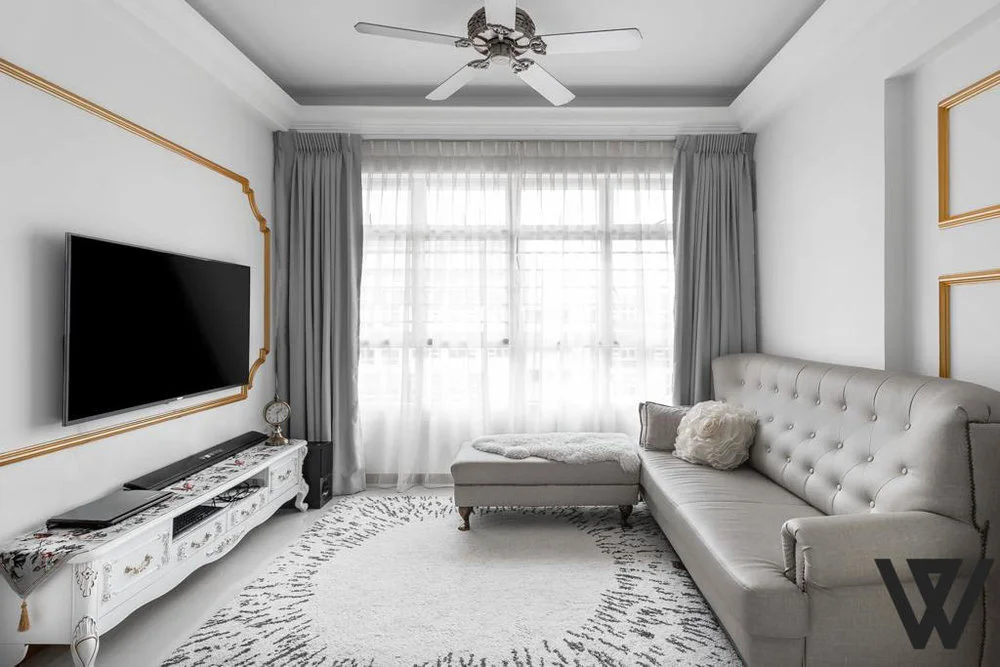
Scandinavian is one of Swiss Interior's signature looks, and our Blk 443B West Ridges Bukit Batok 4 Room, BTO is a clean example of why it works so well in local flats. It's the brighter, cosier cousin of the styles above: white walls, light wood floors, then a layer of softness on top, a chunky wool throw, a few playful accents the stricter minimalist styles wouldn't allow.
The reason Scandinavian style suits Singapore HDB flats so well is the light. Pale surfaces bounce what little natural light a flat gets, so even a north-facing living room feels airy and open. Here, the white-and-timber base keeps everything bright while the textiles stop it from feeling sterile. It's forgiving of everyday clutter and easy to live with, which makes it a sensible first choice if you're nervous about committing to something more specific.
5. Modern Luxury
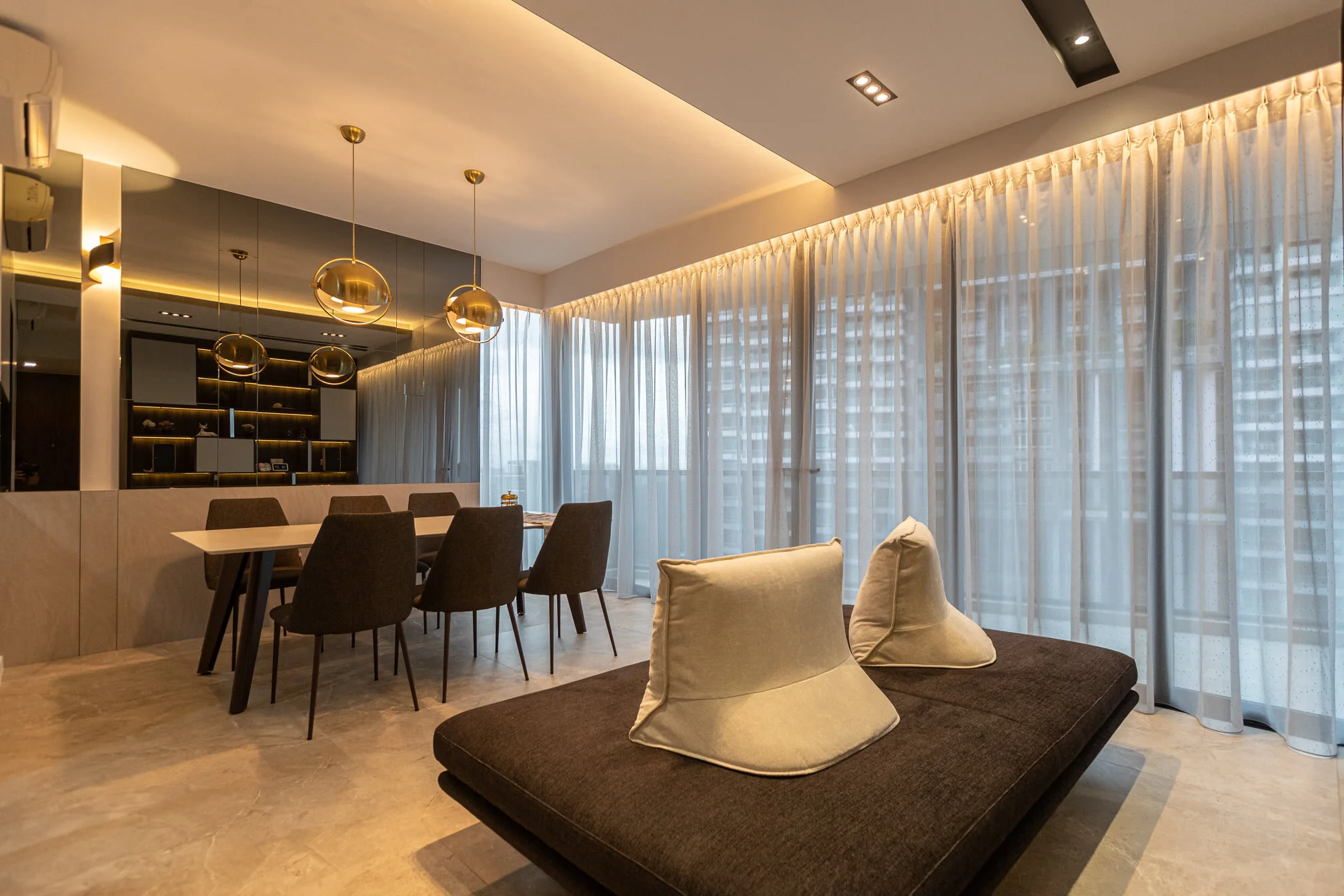
Modern luxury makes its statement through material and proportion rather than ornament, which is exactly why it sits so well in a condo like our featured 3-bedder at Artra. No gold, no chandeliers. Instead, a standout material does the heavy lifting, a slab of veined stone or a rich timber feature, with a tight, warm palette letting it breathe.
A handful of exceptional pieces replace a roomful of decorative ones, and everything around the hero element stays deliberately quiet so it can be the event. It's the natural step up from warm minimalism when the budget allows, and the most-requested high-end look of 2026. We pull it apart in detail, costs and all, in our guide to luxury interior design in Singapore.
6. Industrial

Industrial is the boldest style on this list, and our Blk 788 Woodlands Executive shows the softened, liveable version that actually suits Singapore homes. The bones are there, a microcement or screed finish, black metal framing, exposed track lighting, but they're warmed up with timber and leather, so the home reads as characterful rather than cold.
A maisonette, with its volume and staircase, makes a great canvas for it. The thing to watch is balance: too much raw material and a home starts to feel like an office, so the warm-industrial approach keeps the edge without losing the comfort. It photographs beautifully and rewards open-plan layouts and double-height spaces.
7. Mid-Century Modern
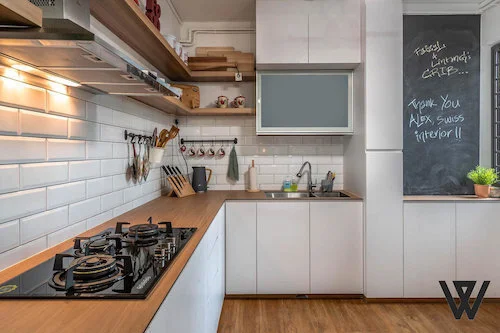
Mid-century modern has aged remarkably well, and our wood-themed 5-room resale at Teck Whye Lane leans into exactly what makes it work here: warmth. The signatures are all present: walnut and teak tones, furniture on slim tapered legs, clean retro silhouettes, and colour used with restraint, a deep olive or burnt orange as an accent rather than a whole wall.
The woodiness feels right in our context, and raised-leg furniture makes a living room feel lighter because you can see the floor flowing underneath. A larger resale flat gives the style room to breathe. It mixes happily with Scandinavian and Japandi too, so it's a good pick if you want warmth and personality without going fully maximalist.
8. Wabi-Sabi
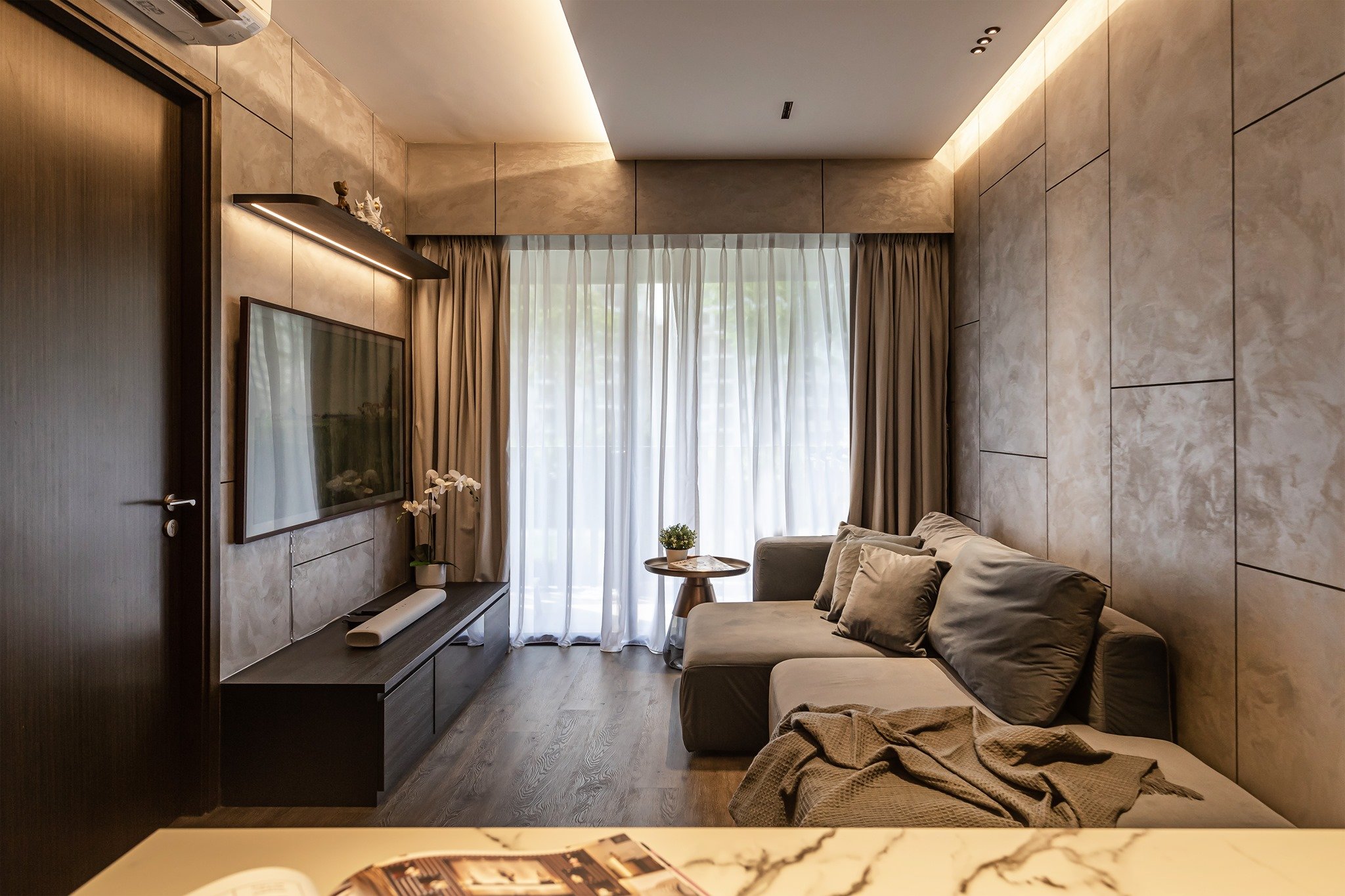
Wabi-sabi style is the quietest, most philosophical style here, finding beauty in imperfection, the handmade, the weathered, the slightly irregular. In a calm condo like Grandeur Park, it shows up as microcement walls with subtle tonal variation, organic curved forms instead of hard edges, raw-edged timber, and a palette pulled straight from the earth: clay, stone, sand.
Nothing is glossy or perfectly uniform, and that's the entire intention. It's a style for people who find conventional minimalism a little too sharp and want something softer and more grounding. It asks for genuine craftsmanship, because doing 'imperfect' well is harder than it sounds, but the payoff is a home that feels deeply calming and completely unlike anyone else's.
9. Peranakan-Modern

Peranakan-modern is Singapore's own, and it's having a real moment. An older resale flat like Blk 63 Telok Blangah makes a fitting canvas, taking heritage details, vivid floral tiles, traditional metal or timber grillework, rattan panelling, and setting them inside a clean, contemporary shell so they read as a deliberate feature rather than a museum piece.
Picture a run of patterned Peranakan tiles as a kitchen backsplash against otherwise plain cabinetry, or a piece of reinterpreted grillework as a room divider. The restraint is what keeps it modern: one or two heritage gestures, not ten. For homeowners who want a home that feels rooted in place and a little bit personal, nothing else on this list does it quite the same way.
10. Tropical / Resort
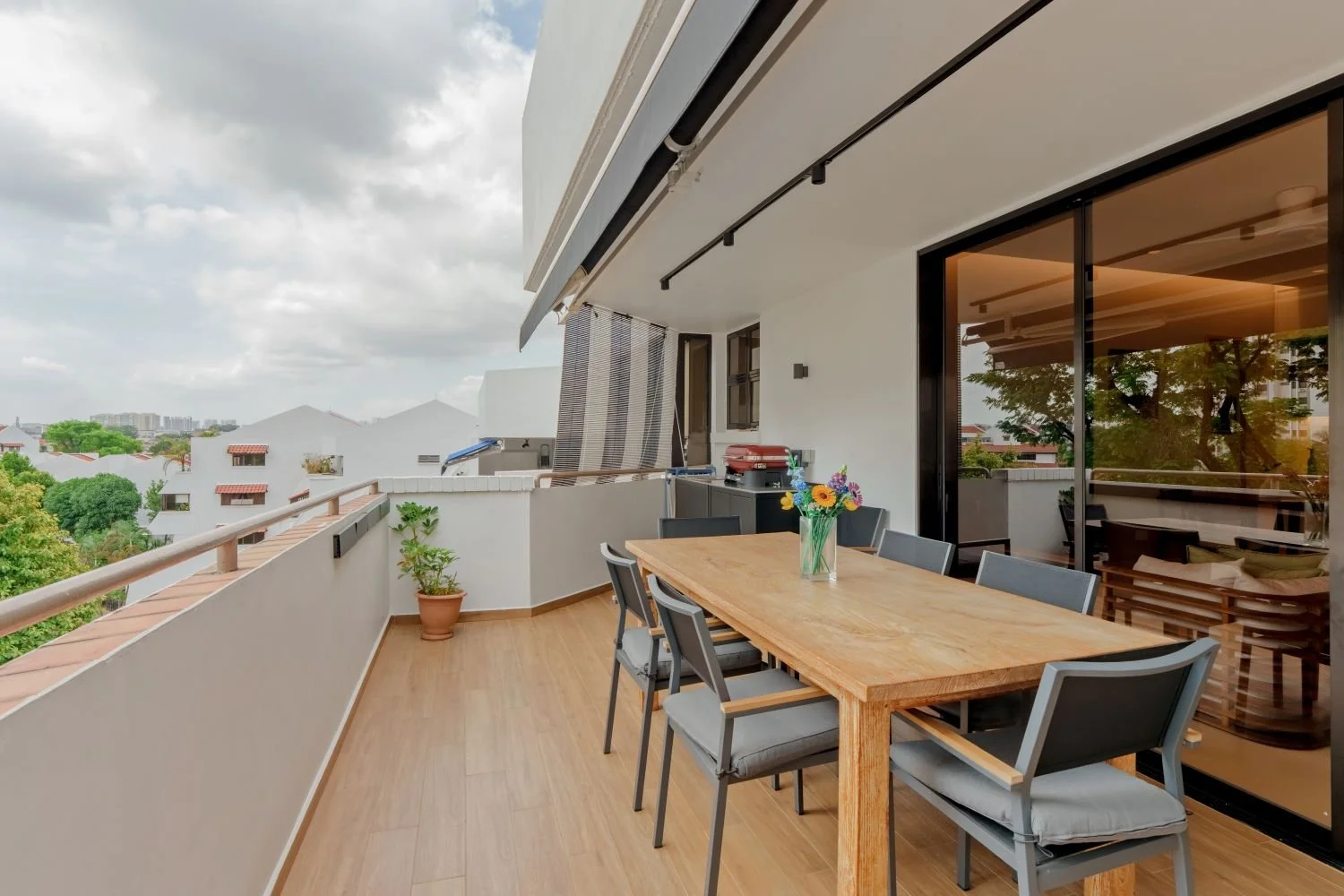
The most climate-appropriate style on the list, tropical or resort design leans into where we actually live: natural rattan and timber, indoor plants, breezy neutral palettes and a strong indoor-outdoor connection through large windows and sheer curtains.
It borrows from the biophilic idea that greenery and natural texture make a home calmer. I recently went to a friend’s house who had followed the design, and with a balcony, it felt like a permanent holiday. In an HDB flat, a few rattan pieces and a plant corner get most of the way there.
How To Actually Choose Your Style
Start with your flat, not the mood board. Small and dark leans you towards the lighter styles, Warm Minimalism, Scandinavian, Muji, that bounce light around, while a larger or double-volume space can carry Industrial or full Modern Luxury without feeling heavy.
Then be honest about upkeep: gloss and stark white show every mark in our humidity, so matte and mid-tones are kinder to daily life. Finally, separate the shell from the styling.
Commit the renovation budget to a flexible neutral base and express the style through furniture, lighting and textiles you can change later, and you keep the option to evolve without hacking anything out. Most Singapore homes end up blending two of these anyway, a Japandi shell with mid-century furniture, say, which is completely fine as long as the palette stays disciplined. Let's have a quick recap.
Warm Minimalism: Best for small HDBs. Calm and warm. Works best in 3 to 5-room HDB flats.
Scandinavian: Best for bright homes. Light and cosy. Works best in HDB flats and condos.
Japandi: Best for clutter-free homes. Calm and refined. Works best in HDB flats and condos.
Muji: Best for families. Practical and organised. Works best in HDB flats.
Modern Luxury: Best for premium homes. Polished and sophisticated. Works best in condos and larger HDB flats.
Industrial: Best for larger spaces. Raw and edgy. Works best in maisonettes and condos.
Mid-Century Modern: Best for character-led homes. Warm and retro. Works best in HDB flats and condos.
Wabi-Sabi: Best for low-fuss homes. Organic and imperfect. Works best in HDB flats and condos.
Peranakan-Modern: Best for character homes. Local and colourful. Works best in HDB flats.
Tropical / Resort: Best for nature lovers. Relaxed and airy. Works best in condos and larger HDB flats.
How to Actually Choose Your Interior Design Style
Staring at nine styles can be paralysing, so a couple of shortcuts. First, ignore the labels for a moment and notice what you keep saving. If every image you bookmark has warm wood and clear surfaces, your answer is somewhere in the minimalist-Japandi-Muji family, whatever you end up calling it.
Second, be honest about how you live. Wabi-sabi and industrial look stunning in photos but require a certain discipline; if you've got young kids and a lot of stuff, a forgiving Scandinavian or warm minimalist base will serve you better day to day.
And you don't have to pick just one. Most of the best Singapore homes blend two related styles, a warm-minimalist base with mid-century furniture, say, or Japandi with a single Peranakan feature. The trick is to let one style lead and the other support, rather than giving them equal billing. Once you've settled on a direction, it's worth reading up on the HDB renovation process so your style choice and your layout changes are planned together rather than one after the other.
Bringing your Interior Design Style to Life
Whichever direction pulls at you, the jump from a saved folder of images to a finished home is where a designer earns their keep, translating a mood into a layout, a materials list and a budget that holds. That's the part we love. Talk to Swiss Interior about the look you're after, or browse our HDB interior design ideas for 2026 to see more of these styles at work in real Singapore flats.
Frequently asked questions
What are the different types of interior design styles in Singapore?
The styles most relevant to Singapore homes in 2026 are warm minimalism, Japandi, Muji, Scandinavian, modern luxury, industrial, mid-century modern, wabi-sabi and Peranakan-modern. Most share a leaning toward natural materials and a restrained palette, but each differs in mood, from the cosy brightness of Scandinavian to the soulful imperfection of wabi-sabi.
What are some popular interior design styles in Singapore?
Warm minimalism. It keeps the clean, uncluttered feel of classic minimalism but adds warmth through natural colours, timber and texture, which suits compact local homes and family living. Japandi runs a very close second for similar reasons.
What are the top 10 interior design styles?
The top 10 interior design styles for Singapore homes are warm minimalism, Japandi, Muji, Scandinavian, modern luxury, industrial, mid-century modern, wabi-sabi, Peranakan-modern and tropical/resort. The first four dominate HDB flats because they suit compact layouts and humid weather, while modern luxury, industrial and tropical/resort come into their own in condos and larger homes.
What are the top 5 styles of interior design?
The five most requested styles in Singapore right now are warm minimalism, Japandi, Muji, Scandinavian and modern luxury. Warm minimalism leads by a clear margin, with roughly four in five of our enquiries asking for some form of minimalism, and Japandi runs a close second. Modern luxury is the top choice at the condo end of the market.
What is the 3-5-7 rule in decorating?
The 3-5-7 rule is a styling guideline that says decorative items look best grouped in odd numbers, usually three, five or seven. Odd-numbered groupings feel more natural and draw the eye around the arrangement, while even numbers tend to look stiff and symmetrical. In a Singapore flat, three is usually enough for a TV console or a shelf; five or seven works better on a larger feature wall or a dining sideboard. Varying the heights and textures within each group makes the rule work even better.
How do I choose an interior design style for my home?
Start by noticing the images you instinctively save; the common threads usually point to a style family before you can name it. Then weigh how you actually live: forgiving styles like Scandinavian and warm minimalism suit busy households, while wabi-sabi or industrial reward a more disciplined, clutter-free lifestyle.
What is the difference between the minimalist and the Japandi style?
Minimalism (especially warm minimalism) is about clean, uncluttered space with subtle texture. Japandi takes that base and adds more soul and contrast, darker grounding accents, low-slung furniture, and a more curated, wabi-sabi-influenced feel. Japandi is a little warmer and more layered; minimalism is more pared back.
Can I mix interior design styles?
Yes, and most well-designed Singapore homes do. The key is to let one style lead and use the other for support, rather than splitting them evenly. A warm-minimalist base with mid-century furniture, or Japandi with a single Peranakan feature wall, both work beautifully when one clearly dominates.
What's the difference between modern and contemporary interior design?
Modern refers to a specific 20th-century movement with defined mid-century roots, so it doesn't change. Contemporary simply means whatever is current, so it shifts over time and today looks like clean lines, neutral bases and mixed materials. A room can be contemporary without being modern.